July 2022 - The physics of energy is enriched by the tools of image synthesis to open up new climate services
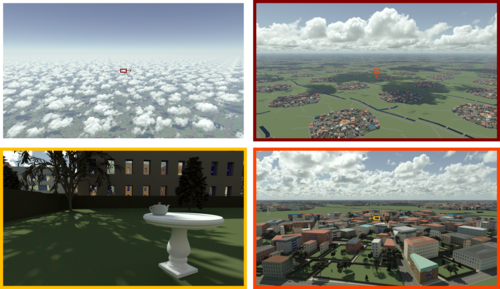
Physically-based renderings from « The Teapot in a City under Cumulus Clouds » movie, illustrating huge spatial scale ratios in urban geometries.
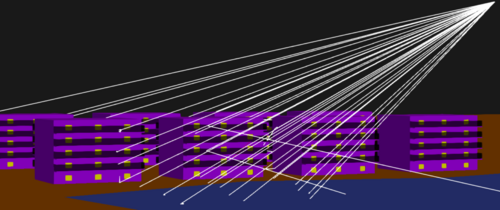
Thermal paths sampled from a virtual camera toward a city geometry
All energy systems professionals express this in their core business: doing better than producing qualitative predictions of thermal behaviour is an almost impossible challenge. From the millimetre of a thermal seal or the thickness of a pane of glass to the ten kilometres or so of urban sprawl; from the minute of fluctuating wind or sunshine to the fifty-year lifespan of an installation: when an energy system involves such scale ratios, its analysis, sizing and optimisation are deemed impossible. We are then forced to make descriptive compromises whose impact can only be measured by experts. These difficulties lie at the heart of current attempts to develop climate services, which, when applied to the energy sector, are intended to provide a link between climate change forecasting and the political choices made when installing systems that anticipate future environmental conditions.
In this perspective article, we propose a new paradigm for modelling energy systems in a changing climate: the « teapot in the city ». « City », because the demonstration of this paradigm concerns the city, which is a key issue in adapting to climate change; « teapot » refers to the concept of the « teapot in the stadium » in computer graphics, a community which, for the film and video game industry, has tackled and resolved the issue of managing large scale ratios for modelling the propagation of light in infinitely detailed virtual scenes.
This IT revolution is at the root of our proposal, which has since been enriched by two elements: on the one hand, major theoretical advances in statistical physics enabling us to extend the tools of computer graphics beyond light alone to the propagation of energy in a broader sense; on the other hand, the integration of data from climate simulations enabling us to take account of fluctuations in weather conditions on all scales.
