July 2023 - Symbolic Monte Carlo methods for analysing the effect of surface albedo on solar radiation in cloudy atmospheres
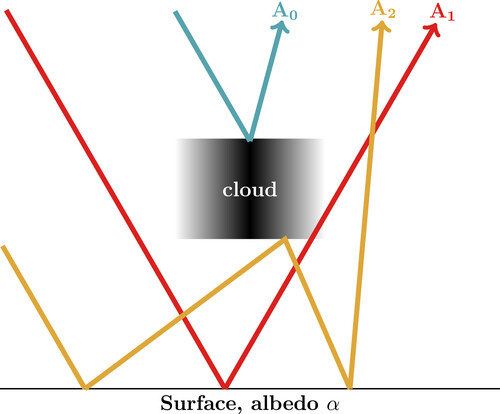
Splitting the radiative flux at the surface of the Earth as function of the number of reflection events.
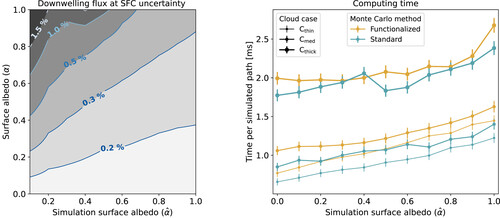
Relative uncertainty and computation time pour a standard Monte Carlo algorithm and a symbolic one, as function of surface albedo.
In the Journal of Advances in Modeling Earth Systems, we discuss the design and use of a so-called Symbolic Monte Carlo algorithm to analyse how the albedo of the Earth's surface affects the solar radiative fluxes reflected by the cloudy atmosphere (Functionalized Monte Carlo 3D Radiative Transfer Model: Radiative Effects of Clouds Over Reflecting Surfaces). Here, the algorithm is designed using an importance sampling approach. The first step is to write the integral formulation associated with the standard algorithm and then to isolate the parameter of interest (in this case the surface albedo) by transferring it to the path weights so that the path sampling procedure no longer depends explicitly on the parameter. A simulation is then carried out and sufficient information is retained along each path to be able to correct the weights a posteriori, for any new value of the parameter of interest.
In our previous experiments with symbolic algorithms based on importance sampling, we encountered variance problems when the value of the parameter for which the function is evaluated is too far away from the parameter used in the simulation. Here, we show that there is a value of the simulation parameter that is optimal in the sense that the paths sampled for this value (1) contain all the information needed to evaluate the flows for all the other values of the parameter. In fact, the longer the paths sampled (made up of numerous bounces), the more complete the information associated with each path. The short paths, preferentially encountered at low albedo values, can be seen as a sub-part of the longer paths sampled for high albedo values.
In fact, this optimal value corresponds to a configuration without parameters i.e. without importance sampling. Starting from a design based on importance sampling, we actually fall into another family of symbolic algorithms. In this particular case, this new approach leads to estimators with low variance. In what situations could this family of algorithms be deployed? Can these algorithms be conceived as anything other than a borderline case of algorithms based on importance sampling?
