Septembre 2023 - Wave-scattering by complex and distributed three-dimensional objects
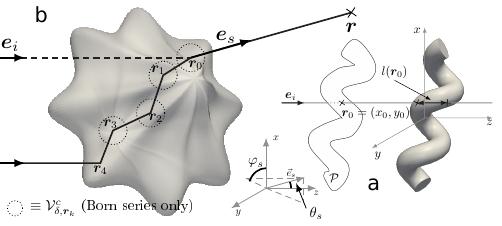
Path spaces for wave-scattering processes
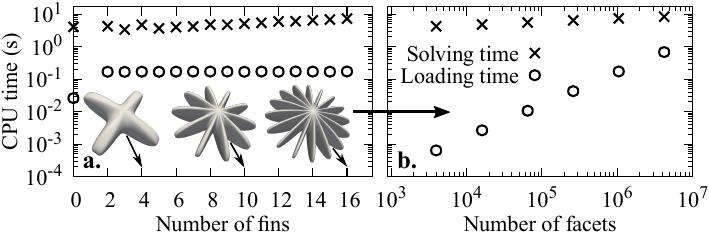
No sensitivity to the complexity and refinement levels of geometry
We recently presented a new statistical perspective on wave single-scattering by complex three-dimensional objects in Optics Letters Wave-Scattering processes: path-integrals designed for the numerical handling of complex geometries), with special emphasis on obtaining the radiative properties of complex shaped particles by solving electromagnetic scattering (absorption and scattering cross-sections; phase function). We have produced sampling procedures insensitive to geometric complexity for the stochastic processes associated with three models - Schiff's approximation, Born approximation and an infinite, rigorous, Born series - thus enabling us to handle any low-contrast particle.
We fully implemented this probabilistic approach for Schiff’s approximation in a free and open-source software application (Schiff software website). We reproduce here a graph illustrating two properties of this new approach: - calculation time doesn't increase as particle geometry becomes more complex; - computation time does not increase as the geometric description of a given particle is refined.
Other results presented in the article show that the computation time does not increase when we add averaging on particle shape, size and orientation distributions.
Commonly recognized features of the Monte Carlo method can now be available when solving electromagnetic scattering. In so doing, we are able to produce spectral and angular radiative properties of helical-shaped microalgae Arthrospira platensis in 20 min, whereas this required several months with a straight cylinder model using deterministic methods.
