January 2024 - Nonlinear coupling of radiative transfer and gas spectroscopy
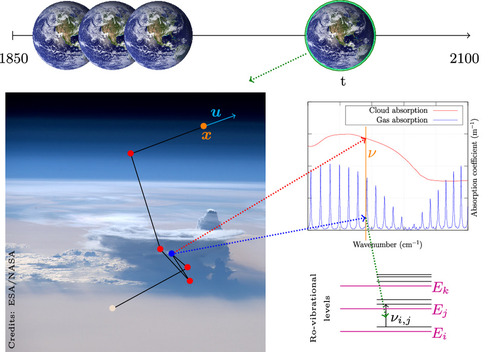
Integration-domain complexity
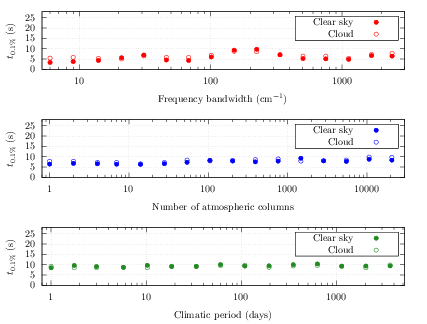
No sensitivity of computation time to the enlarging of the integration domains, for scattering and non-scattering atmospheres.
Our work on the Monte Carlo method for handling quantum molecular spectroscopy on a line-by-line basis, with the objective of analyzing terrestrial radiation, has been published in PNAS (Proceedings of the National Academy of Sciences of the United States of America) in the Brief Report format (Spectrally refined unbiased Monte Carlo estimate of the Earth’s global radiative cooling).
We are at the interface between Statistical Physics and Computer Graphics. The two phenomena involved, radiation and spectroscopy, each undergo a translation into a path-space. For radiation, standard photon paths are introduced that can be envisioned quite straightforwardly. In the case of spectroscopy, the space considered is structured as a binary tree classifying the set of all possible energy transitions from one molecular state to another.
What mainly gives the procedure its originality is the fact that the coupling is nonlinear, and this nonlinearity can be managed with an adapted version of a null-collision algorithm. The PNAS article focuses on the core ideas; at this stage, theoretical and algorithmic details are only published in the doctoral dissertation of Yaniss Nyffenegger-Péré. However, you will find a comprehensive demonstration of the resulting computational efficiency. Here, we reproduce the three plots that demonstrate that computation time is not higher when estimating a radiative quantity integrated over a narrow spectral band or over the entire infrared range, integrated over an atmospheric column or over the entire Earth, integrated over one day or over ten years. Most importantly, these computational requirements are on the order of ten seconds on a laptop, achieving a relative accuracy of 1/1000.
